Gutter Solutions — Shielding Your Home from Water Damage
Sure Thing Roofing Contractor • Peachtree City, GA • Atlas Pro+ Certified • More than 60 Five-Star Reviews
Here is a number that most homeowners do not think about until they are writing a large check: the average cost of foundation repair caused by water intrusion in Georgia is $8,000 to $30,000. The average cost of a functioning seamless gutter system for the same home is a fraction of that. The math is not complicated. What is complicated is knowing what a proper gutter system actually looks like, why Georgia conditions make material and installation choices matter more than they do in drier climates, and how to tell the difference between a gutter that is working and one that is quietly routing storm water toward your foundation.
Sure Thing Roofing Contractor — Peachtree City's trusted Storm Doctors — has assessed gutters on hundreds of homes throughout Fayette and Coweta counties. The pattern is consistent: most of the water damage we find at fascia boards, soffits, and foundations traces back not to the storm itself, but to gutters that were the wrong material, the wrong size, improperly sloped, or discharging too close to the house. This guide gives you the complete picture.
Aluminum vs. Vinyl vs. Copper: Which Gutter Material Is Right for a Georgia Home?
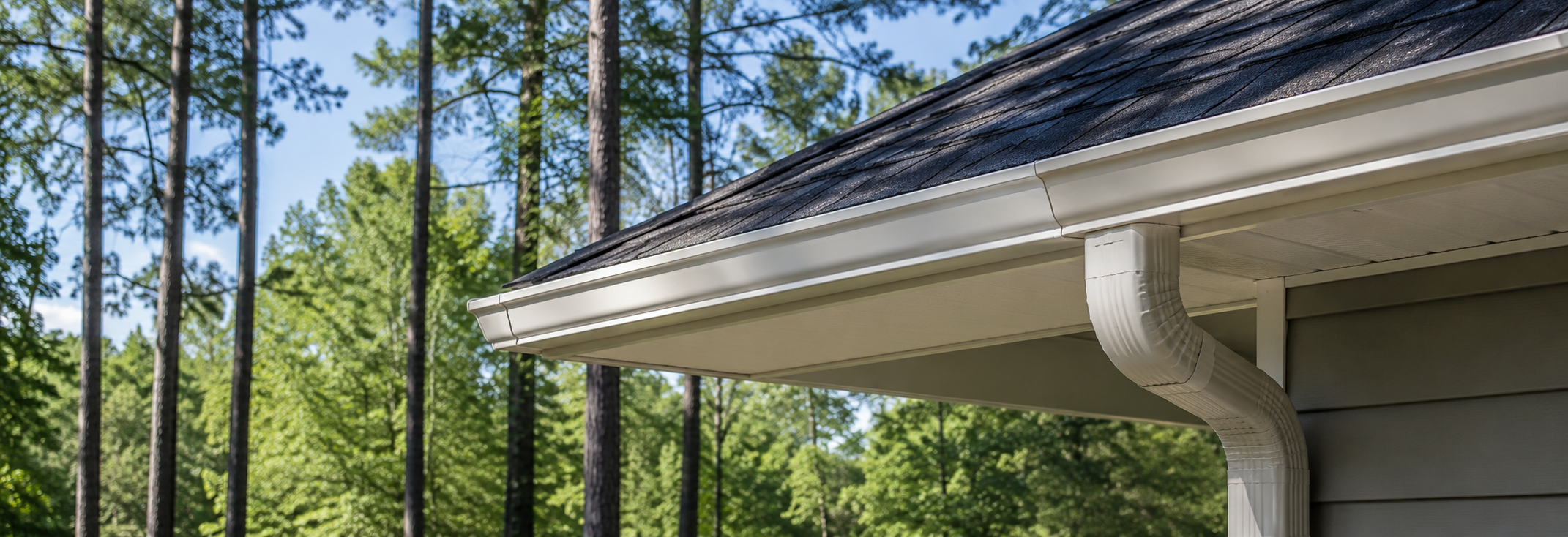
For most homes in Peachtree City and the surrounding Georgia communities, aluminum seamless gutters are the most practical long-term choice — they resist rust, handle Georgia's high rainfall volume, and do not become brittle under intense UV exposure the way vinyl does. Copper is the premium lifetime option. Vinyl is the budget option that typically fails in under fifteen years in this climate.
Not all gutters perform the same way in Georgia's climate. The combination of intense summer UV, high annual rainfall, freeze-thaw cycling in winter, and the sheer volume of debris from pine and hardwood canopy puts different demands on gutter materials than a drier northern climate would. Here is how the three common choices actually compare:
Material
Lifespan in Georgia
Best For
Key Limitation
Aluminum (Seamless)
20–30 years
Most residential homes — the practical standard choice
Can dent from large hail or falling limbs; must be painted if appearance is a priority
Copper
50–100+ years
Homes where permanent installation and curb appeal are priorities
Costs three to four times more than aluminum; requires specialized installation
Vinyl (PVC)
10–15 years
Budget replacement; structures where appearance is less critical
Becomes brittle under Georgia UV; expands and contracts with temperature swings, loosening seams
Steel (Galvanized)
15–20 years
Commercial applications; not standard for residential
Subject to rust at the seams and any areas where galvanized coating is scratched
The seamless difference matters for Georgia homes specifically. Sectional gutters — the kind you assemble from pre-cut lengths — have joints every ten feet. Every joint is a potential leak point as sealant ages and the metal expands and contracts through Georgia's seasonal temperature range. Seamless gutters are cut on-site to the exact length of each run, with joints appearing only at corners and downspout connections. Fewer joints means fewer failure points, and in Georgia's storm environment, that is not a small distinction.
Five-inch K-style gutters are the standard residential width for most Peachtree City homes. Six-inch gutters handle higher volume and are appropriate for larger roof sections, steeper pitches, or areas with dense tree canopy that can partially restrict flow during a heavy rain event. Undersized gutters overflow under normal storm conditions in Georgia — this is not a matter of how well the gutters are maintained, but of capacity.
Why Downspout Positioning and Extension Are the Most Under-Discussed Gutter Problem
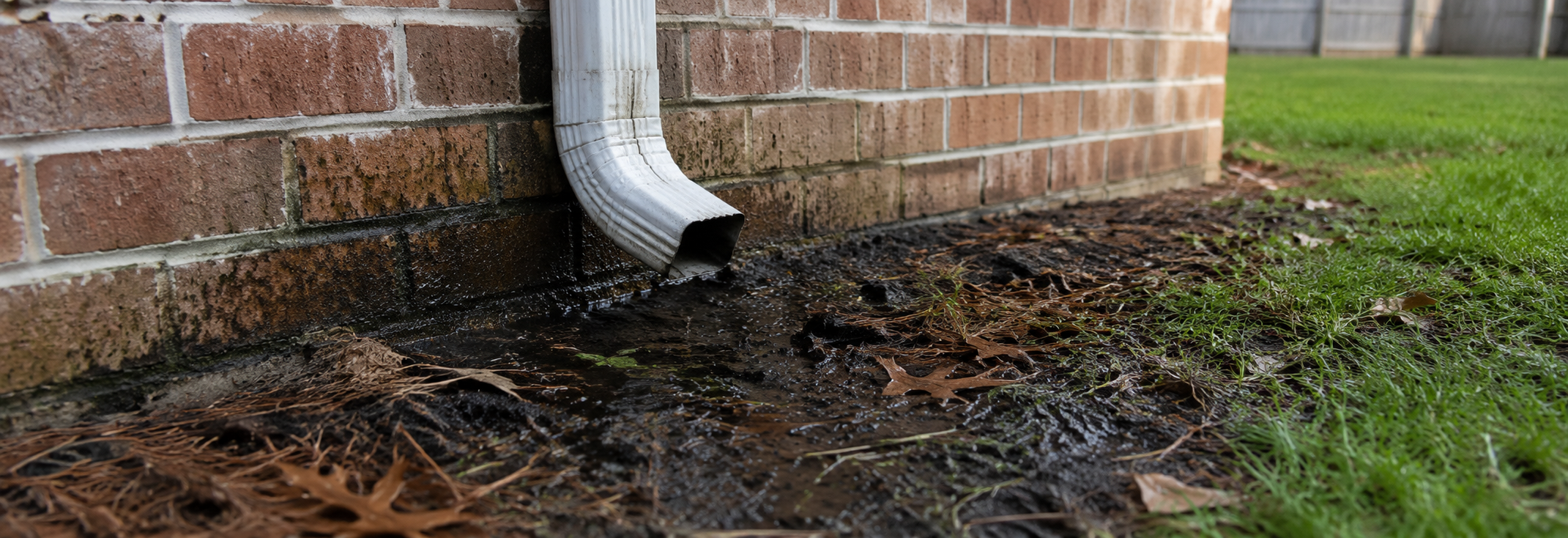
Downspout positioning is the most under-discussed gutter failure point because homeowners focus on the gutter channel itself and not on where the water goes after it exits the downspout. On Georgia clay soils, downspouts must discharge at least six to ten feet from the foundation — clay saturates quickly and holds water against foundation walls when discharge is too close.
Walk around any established neighborhood in Peachtree City, Fayetteville, or Newnan and look at where the downspouts end. A significant number terminate at the base of the wall with a splash block, or with no extension at all. The homeowner sees water pouring away from the house. What they do not see is what happens to that water three minutes later.
Georgia's red clay soil has two properties that make downspout positioning a structural concern, not just an aesthetic one:
Slow absorption rate: Red clay absorbs water slowly compared to sandy or loamy soils. During a heavy Georgia storm that delivers one to two inches of rain in an hour, the soil within six feet of a downspout discharge point can be fully saturated before the storm ends. After saturation, all additional water moves horizontally — toward the foundation.
Expansion and contraction: Georgia clay expands significantly when wet and contracts when dry. Repeated cycles of saturating and drying the soil directly against your foundation creates the conditions for foundation movement, particularly in homes built on cut-and-fill lots where the original soil composition varies across the footprint.
The practical standard for downspout discharge in Georgia clay environments is six to ten feet from the foundation perimeter. This distance gives storm water enough horizontal travel to slow and begin absorbing before reaching the foundation wall. The options for achieving this distance:
1
Downspout ExtensionsSimple corrugated plastic or aluminum extensions attached to the downspout outlet — inexpensive, effective, and the minimum solution for most homes where discharge is currently too close
2
Splash Blocks with SlopeConcrete or plastic channels that direct water away from the foundation when the grade around the home is adequate to carry the flow outward — effective if the soil grade supports it
3
Underground Drain LinesPVC pipe buried below grade carries downspout discharge to a daylight outlet, a dry well, or a collection point well away from the foundation — the permanent solution for homes where surface extensions are not practical
4
Rain BarrelsCollect and reuse downspout water for irrigation — effective at managing discharge volume during moderate rain events, but overflow routing must still direct water away from the foundation
Not Sure Where Your Downspouts Are Discharging?Sure Thing Roofing Contractor's no-cost inspection covers downspout condition, discharge distance, and any signs of water intrusion at the foundation perimeter. Written report included.
What Is Grading and How Does It Affect Gutter Performance?
Grading is the slope of the soil surrounding your home's foundation. Proper grading directs surface water away from the house; negative grading allows storm water to collect at the foundation perimeter. Gutters and downspouts that function perfectly can still cause foundation damage if the soil around the house slopes inward, because the discharge still pools against the wall.
Gutters handle water that falls on the roof. Grading handles water that falls on the ground and water that exits the downspouts. Both halves of your home's drainage system must function together or the result is the same: water held against the foundation.
The Georgia-specific grading challenge is the combination of clay soil and the development patterns common in Peachtree City and the surrounding communities. Many homes in this area were built on cut-and-fill lots — where the original terrain was leveled by cutting soil from high areas and filling in low ones. Over fifteen to twenty years, fill soil settles. A lot that had adequate outward slope at the time of construction can develop low spots and inward slopes as the fill compacts unevenly.
The signs of a grading problem around your home:
Water pooling within six feet of the foundation after rain
Soil or mulch that has washed away from the foundation perimeter, leaving bare soil
Persistent wet areas against the foundation wall that do not dry out between rain events
Efflorescence (white mineral deposits) on masonry foundation walls — a sign of repeated water migration through the wall
Basement or crawl space moisture that appears during or after rain events rather than during dry weather
When a grading issue is present, fixing the gutters alone does not solve the water intrusion problem. The two systems must be addressed together. Sure Thing Roofing Contractor's inspection reports note grading concerns alongside gutter and roof findings so homeowners have a complete picture rather than piece-by-piece repairs that do not address the underlying drainage pattern.
What Storm-Damaged Gutters Look Like vs. Healthy Gutters
Storm-damaged gutters show sagging sections, brackets pulled from the fascia, separated seams, dented or crushed downspouts, and visible separation from the roofline. Healthy gutters run straight and level, sit flush against the fascia with no visible daylight between the gutter back and the fascia board, and show no standing water in the channel after the rain stops.
After a significant Georgia storm — the kind that brings 50 to 70 mph winds and heavy rain to Fayette and Coweta counties in spring and summer — a ground-level inspection of your gutters takes ten minutes and can identify problems that will become serious if left unaddressed through the next rain event.
Storm Damage Warning Signs: What to Look for From the Ground
Sagging sections: A gutter section that bows downward in the middle has either accumulated enough debris weight to pull brackets loose, or was impacted by wind-driven debris. Sagging creates a low point where water pools rather than drains — standing water accelerates corrosion and adds continuous weight that worsens the sag over time.
Visible daylight between gutter back and fascia: When a gutter pulls away from the fascia, it creates a gap that allows water to run behind the gutter channel and directly onto the fascia board rather than into the gutter. Fascia rot follows within months of this failure.
Separated joints at seams: The sealant at gutter section joints ages and loses adhesion. A storm that drives water at high velocity through the gutter channel can force water through a weakened seam even if the joint looked intact before the storm. Look for rust staining or mineral deposits on the siding directly below a gutter seam as evidence of an existing leak.
Dented, crushed, or disconnected downspouts: Hail and falling limbs — both common in Georgia storms — dent downspout sections and can separate the downspout from the elbow connection at the outlet. A disconnected downspout dumps all of its collected water at the base of the wall.
Water staining on siding or foundation below the gutter run: Vertical streaking on the siding or foundation directly below the gutter line indicates overflow. The gutter is running at or beyond capacity during rain events and spilling over the front edge. This is either a debris blockage or an undersized gutter for the roof surface it serves.
Pine needle or debris compaction visible from the ground: If you can see the gutter channel is full of debris from ground level after a storm, the downspout is likely blocked. A blocked downspout with a full gutter channel will overflow at the first point of weakness — usually a joint seam or the gutter back behind debris buildup.
If you find any of these warning signs after a storm, the next step is a professional inspection. Several of them — particularly bracket failure, joint separation, and any condition at the fascia level — are signs that the gutter system needs repair before the next rain event, not at some future convenience. Leaving a sagging or separated gutter in place through another Georgia storm simply extends the damage it is already causing.
The connection between gutter condition and roof repair needs is more direct than most homeowners realize. When gutters overflow repeatedly, water backs up under the drip edge at the eave. The drip edge is the metal flashing that directs water from the roof edge into the gutter. When gutters are full, water has nowhere to go except backward — under the shingle overhang, against the fascia, and eventually into the roof deck. This is the path from "gutter problem" to "roof deck rot" that makes a $400 gutter repair into a $4,000 roof replacement conversation.
Seen Any of These Warning Signs?Do not wait for the next rain event to confirm the damage. Sure Thing Roofing Contractor inspects gutters, fascia, drip edge, and the full roofline at no cost to Peachtree City-area homeowners. Call (678) 781-0045 or schedule online.
Common questions from Peachtree City, Fayetteville, and Newnan homeowners about gutter materials, downspout placement, storm damage identification, and what a failing gutter system actually costs when left unaddressed.
Aluminum seamless gutters are the most practical choice for most homes in Peachtree City and Fayette County. They resist rust, handle Georgia's high rainfall volume effectively, and are available in a wide range of colors to match any roofline. Copper is the premium long-life option that never needs painting, but costs three to four times more. Vinyl is the budget choice but becomes brittle under Georgia's UV intensity and typically fails within ten to fifteen years.
Downspouts should discharge at least six to ten feet from the foundation on Georgia clay soils. Georgia's expansive red clay absorbs water slowly and saturates quickly during heavy storms, which means any water deposited close to the foundation perimeter has nowhere to go except down and inward. Extensions, splash blocks, and underground drainage connections all accomplish the same goal: moving storm water far enough away that it can dissipate before reaching the foundation footprint.
Healthy gutters run straight and level, sit flush against the fascia, and show no visible rust, holes, or separated seams. Storm-damaged gutters show sagging sections from impact or debris overload, brackets pulled from the fascia, separated joints at the seams, dented or crushed downspouts from hail or falling limbs, and visible pulling away from the roofline. Water stains on the siding or foundation directly below the gutter run are a reliable ground-level indicator of overflow damage.
Yes. The damage chain from failed gutters is well-documented: water overflowing onto the fascia begins wood rot within months; saturated fascia boards allow moisture into the soffit and sheathing; long-term overflow against the foundation creates hydrostatic pressure that cracks masonry or shifts footings on Georgia clay. Foundation repair alone ranges from $8,000 to $30,000 in this market. Fascia and soffit replacement, when extensive, adds $3,000 to $8,000. A functioning gutter system costs a fraction of either repair.
Grading is the slope of the soil around your foundation. Proper grading slopes away from the house so that surface water moves outward and does not collect at the foundation perimeter. Even a perfectly functioning gutter system can cause foundation problems if the discharge point empties into flat or inward-sloping ground. Gutters move water off the roof; grading moves it away from the house. Both halves of the drainage system must work together.
Yes. Sure Thing Roofing Contractor provides gutter inspection, repair, and full seamless gutter replacement throughout Peachtree City, Fayetteville, Newnan, McDonough, Griffin, and the surrounding Fayette and Coweta County communities. Every no-cost roof inspection includes a complete gutter system assessment covering bracket integrity, joint condition, downspout discharge distance, and any signs of overflow damage to the fascia or foundation area.
Schedule Your No-Cost Roof Inspection in Peachtree City
If you have a leak, visible storm damage, or a roof that simply has not been looked at in the last few years, do not wait. A no-cost inspection costs you nothing and gives you the honest picture of where your roof stands.
Monday through Saturday, 9 AM to 6 PM. We confirm within one business hour.
 Sure Thing Roofing Contractor