 Sure Thing Roofing Contractor
Call Us Now
(678) 781-0045
Sure Thing Roofing Contractor
Sure Thing Roofing Contractor • Peachtree City, GA • Atlas Pro+ Certified • More than 60 Five-Star Reviews
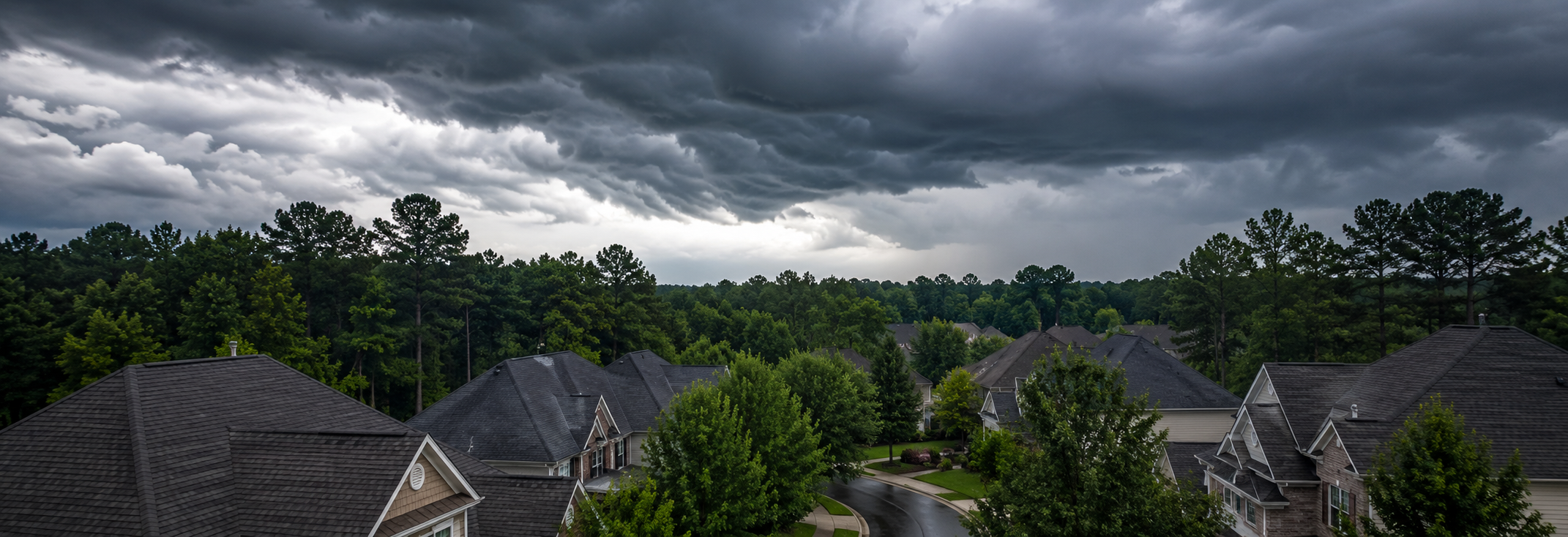
After a major storm moves through Peachtree City, most homeowners do the same thing: they walk outside, look up at the roof from the driveway, and if no shingles are missing, they go back inside satisfied.
That walk-around assessment misses the majority of significant storm damage. It misses it structurally, the way a visual scan of a car after a fender bender misses a bent frame. The damage is real. It is already reducing the remaining life of the roof. And it will eventually demand a far more expensive response than if it had been caught early by a professional with eyes on the actual shingle surface.
This matters specifically in Peachtree City, Fayetteville, and the broader Fayette and Coweta County area because of the storm patterns that run through this part of Georgia. This is not a generic Southeast storm zone. There are specific, named weather corridors that produce the kind of mixed hail-and-wind events that cause the most difficult-to-detect damage. If you live here and own a home, understanding what your roof faces is the first step to protecting it.
Sure Thing Roofing Contractor has been the trusted roofing contractor in Peachtree City since 2015. As an Atlas Pro+ certified contractor with more than 60 five-star Google reviews from Fayette and Coweta County homeowners, we have inspected hundreds of roofs after storms that homeowners thought had passed without damage. This guide explains what those homeowners missed, why it matters, and what to do about it.
Not all parts of Georgia face the same storm risk. Peachtree City, Fayetteville, and the surrounding communities have a specific meteorological exposure that is worth understanding before we get to what it does to roofs.
The area sits directly in the path of moisture-laden systems that track northeast off the Gulf of Mexico and interact with the terrain changes between the Piedmont and Coastal Plain geology. The I-75/I-85 corridor through the Fayette-Coweta region functions as a documented convergence zone where supercell thunderstorms frequently intensify. What this produces in practical terms:
Coweta County, to the west, faces a similar pattern. Newnan homeowners experience the same storm corridor exposure as Peachtree City and Fayetteville. The geography here means that if a storm system is severe enough to make the news in one of these communities, every homeowner in the surrounding area has reason to schedule an inspection.
The walk-around problem is not a matter of effort or attention. A homeowner doing a careful visual inspection from the ground is genuinely looking. They will see missing shingles. They will see obvious impact dents on metal flashing or gutters that caught the same storm. What they will not see is any of the following:
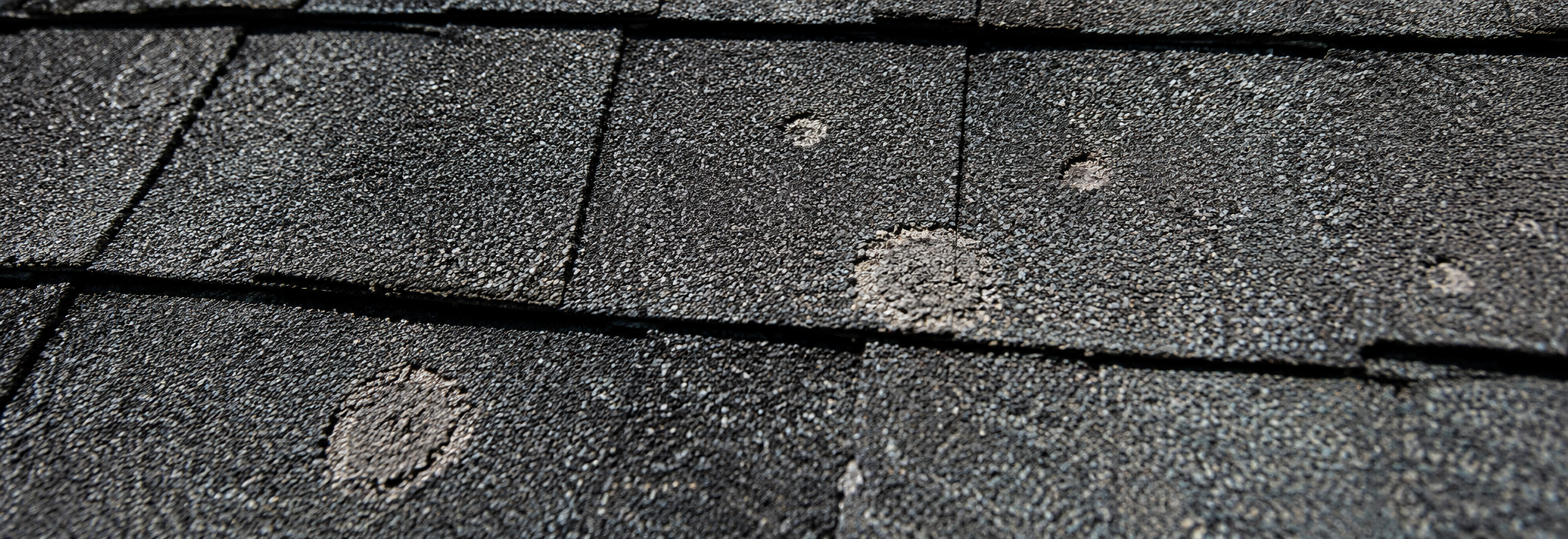
Hail impact displaces granules from a circular area of one to two inches in diameter per impact. On a dark shingle, this creates a slightly different reflectivity that is only distinguishable from three to five feet away. From 20 feet below, the shingle surface appears intact. The missing granule area is now exposing bare asphalt to UV radiation, which hardens and cracks the asphalt at a rate three to four times faster than an intact shingle section.
Larger hail — three-quarter inch and above — can fracture the fiberglass mat beneath the granule layer without displacing the granules visibly. The shingle surface appears undisturbed. Beneath it, the structural integrity of the shingle is compromised. This is called a hidden fracture, and it is identified during a professional inspection by pressing the suspect area to feel the lack of resistance that a fractured mat produces. It is literally invisible from any distance.
Wind speeds above 45 mph can lift the step flashing at chimney bases, skylight perimeters, and wall intersections by a few millimeters without removing the adjacent shingles. A two-millimeter gap in step flashing is functionally invisible at ground level. During a rain event with wind-driven horizontal rain — exactly the conditions that accompany the same storms that lift the flashing — that gap becomes a direct water entry path into the roof deck and wall cavity.
Storm-driven debris — leaves, pine needles, small branches — compacts in roof valleys under the force of moving water. Dense, wet debris resting against valley flashing retains moisture continuously, accelerating corrosion at the flashing edge. This is a slow-developing damage mechanism that begins immediately after a storm and progresses every subsequent rain until the valley is cleared and the flashing is inspected.
Ridge cap shingles rely on an adhesive strip for weather-sealing. High winds activate the strip by putting differential pressure on the cap shingle. After a wind event, the sealant bond may be weakened without the cap being visibly lifted. The cap remains in place. In the next significant wind event, it lifts fully. This is only found by physical examination of the ridge cap adhesion during an inspection.
Rubber pipe boot collars around plumbing penetrations are impact-sensitive. A hail strike on a rubber collar creates a small depression that does not crack immediately but accelerates fatigue in the rubber. Collars that were already aging from UV exposure may crack within one to two seasons after a hail event that would not have cracked a newer collar. They are almost impossible to see clearly from the ground on the typical low-slope roof section where plumbing penetrations occur.
The time problem: Storm damage claims in Georgia are typically subject to a one-year filing window from the date of loss. The damage accumulates quietly for weeks or months while the homeowner assumes everything is fine. By the time a leak appears — often the following storm season — the entry point may have been active long enough that the insurer questions whether the damage is from the named storm or from subsequent wear. A professional inspection immediately after a storm creates a dated record that anchors the claim to the specific event.
Had a Storm Recently?If a significant storm has passed through Peachtree City, Fayetteville, or Newnan in the past 90 days, your roof deserves a professional assessment. Sure Thing Roofing Contractor's no-cost inspection is a complete professional evaluation with a written report. No obligation.
Schedule No-Cost InspectionAfter a major hail or wind event, out-of-state roofing companies follow the storm path into affected areas. They set up temporary operations, hire local labor quickly, move through the community in a concentrated period, and then leave for the next storm event. This model produces a specific set of risks for homeowners that are worth naming directly.
| Factor | Local Licensed Contractor | Storm Chaser |
|---|---|---|
| Georgia contractor's license | Yes — verifiable through state records | Often licensed in home state only |
| Ongoing liability insurance | Maintained year-round for Georgia work | Temporary or lapsed after they leave the market |
| Local adjuster relationships | Established and ongoing | None; unfamiliar with local carrier standards |
| Warranty accountability | Reachable at a local address | May be operating in another state within 90 days |
| Atlas Pro+ certification | Sure Thing Roofing Contractor is certified — Atlas stands behind the work | Most storm chasers are not Atlas-certified |
| Community reputation | More than 60 five-star Google reviews from Fayette and Coweta County neighbors | Reviews scattered across multiple states; no local history |
| Post-installation follow-up | Available for warranty calls, inspector sign-offs, and re-inspections | Often unavailable once they have moved to next storm market |
The storm chaser model works for the contractor, not the homeowner. The speed and volume of post-storm installations prioritizes throughput over installation quality. Atlas Pro+ certification — which Sure Thing Roofing Contractor holds — requires installation to specific standards that must be met for the manufacturer warranty to apply. A contractor who is not Atlas-certified cannot offer an Atlas warranty, regardless of what they say at the door.
Most homeowners do not know they have a claimable storm damage situation until a roof inspection tells them. The inspection is not just about finding damage — it is about creating the documentation that makes a successful claim possible.
Here is how the process works when Sure Thing Roofing Contractor handles the inspection and claim support:
Georgia homeowners should know that many policies require claims to be filed within one year of the date of loss. That window sounds generous until you consider that minor storm damage often goes unnoticed for four to six months. Scheduling an inspection after any significant Fayette or Coweta County storm event protects that claim window.
The steps that matter in the first 48 hours after a significant storm:
Whether the result is a roof repair, a partial replacement, or a full roof replacement, the right answer starts with knowing what the storm actually did to your specific roof — not what a walk-around from the driveway suggests.
If you have a leak, visible storm damage, or a roof that simply has not been looked at in the last few years, do not wait. A no-cost inspection costs you nothing and gives you the honest picture of where your roof stands.
Monday through Saturday, 9 AM to 6 PM. We confirm within one business hour.
Schedule Your No-Cost Roof InspectionOr call us directly: (678) 781-0045
Serving Peachtree City, Fayetteville, Newnan, McDonough, Senoia, Sharpsburg, Griffin, and Douglasville.
Peachtree City’s Atlas Pro+ certified roofer — since 2015. More than 60 five-star reviews.