 Sure Thing Roofing Contractor
Call Us Now
(678) 781-0045
Sure Thing Roofing Contractor
Sure Thing Roofing Contractor • Peachtree City, GA • Atlas Pro+ Certified • More than 60 Five-Star Reviews
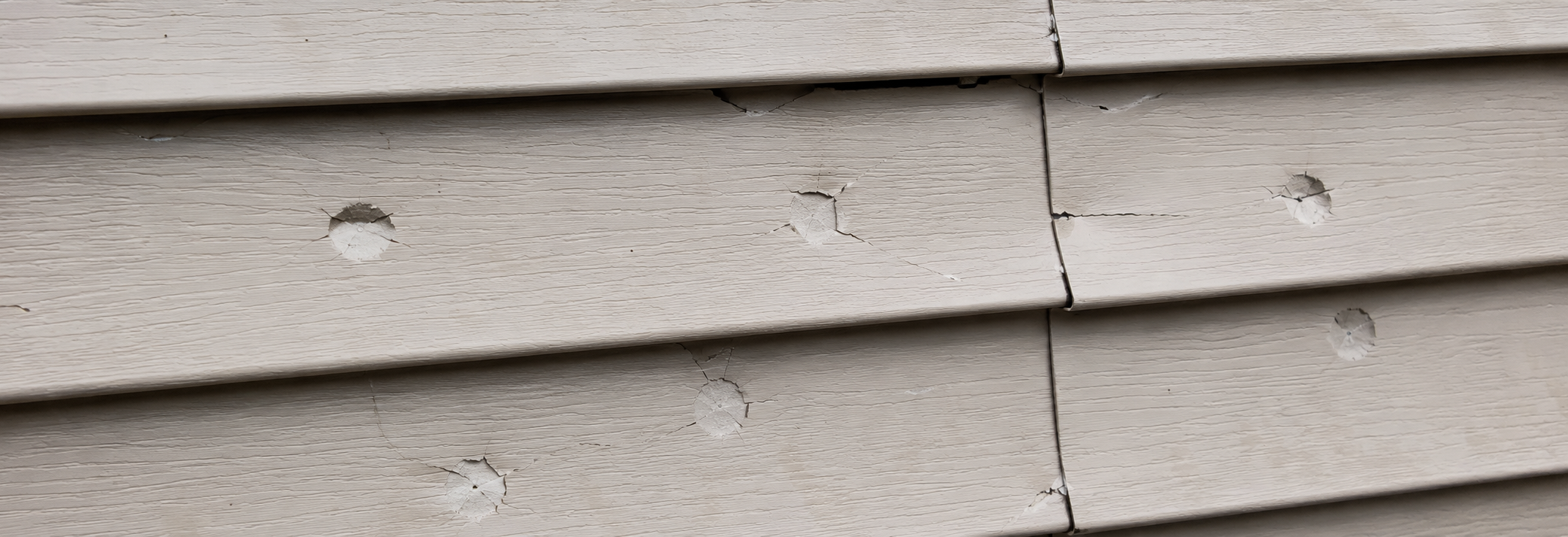
Here is what typically happens after a spring storm rolls through Fayette or Coweta County: a homeowner steps outside, scans the roof from the driveway, notices a missing shingle or two, and calls a roofer. That is a reasonable response. What is not reasonable — and what we see on job after job at Sure Thing Roofing Contractor — is when that same homeowner's siding inspection consists of a five-second glance from the street and the conclusion that it "looks fine."
Siding damage does not announce itself the way a missing shingle does. A hail ding on aluminum siding is a shallow circular dent you will miss unless the light is exactly right. A crack in vinyl siding looks like a shadow. Water infiltration behind the siding is invisible from the outside entirely — you only discover it when drywall starts to bubble or mold appears on an interior wall six months later. By then, the insurance claim window may have closed and the repair bill is yours alone.
Sure Thing Roofing Contractor has earned more than 60 five-star Google reviews because we do not stop at the roof. A complete storm assessment means the full building envelope: roofing, gutters, fascia, soffits, and siding. This guide gives you the field-tested knowledge to identify siding damage before it becomes a hidden water intrusion problem.
The physics of how hail and wind damage siding are fundamentally different from how they damage roofing. A shingle hit by hail loses granules in a visually obvious crater pattern. A vinyl panel hit by the same hail cracks in a way that looks like a surface scratch or a manufacturing line. An aluminum panel dents in a shallow circular pattern that requires low-angle raking light to make visible. Fiber cement panels can develop hairline cracks near the edges and at trim overlaps that are invisible from a standard inspection distance.
Wind compounds the picture. High-speed wind does not just dent or crack the siding face — it drives rain laterally into seams and around flashings in a way that gravity-fed rain never does. A seam that has been adequate for decades of normal rainfall can allow water infiltration the first time a storm delivers 50-mile-per-hour sustained winds. The entry point is a gap of a few millimeters at a horizontal seam joint. What happens next plays out behind the wall, out of sight.
The practical takeaway: after any storm that produced hail large enough to dent a vehicle or sustained winds above 45 miles per hour, include a deliberate siding inspection as part of your post-storm walkthrough. Do not assume because it looks undamaged from the street that it is undamaged.
Georgia homeowners in Peachtree City, Fayetteville, Newnan, and the surrounding communities have homes sided with three primary materials. Understanding how hail damages each one is the first step toward knowing what to look for.
| Siding Type | How Hail Damages It | What It Looks Like | Detection Technique |
|---|---|---|---|
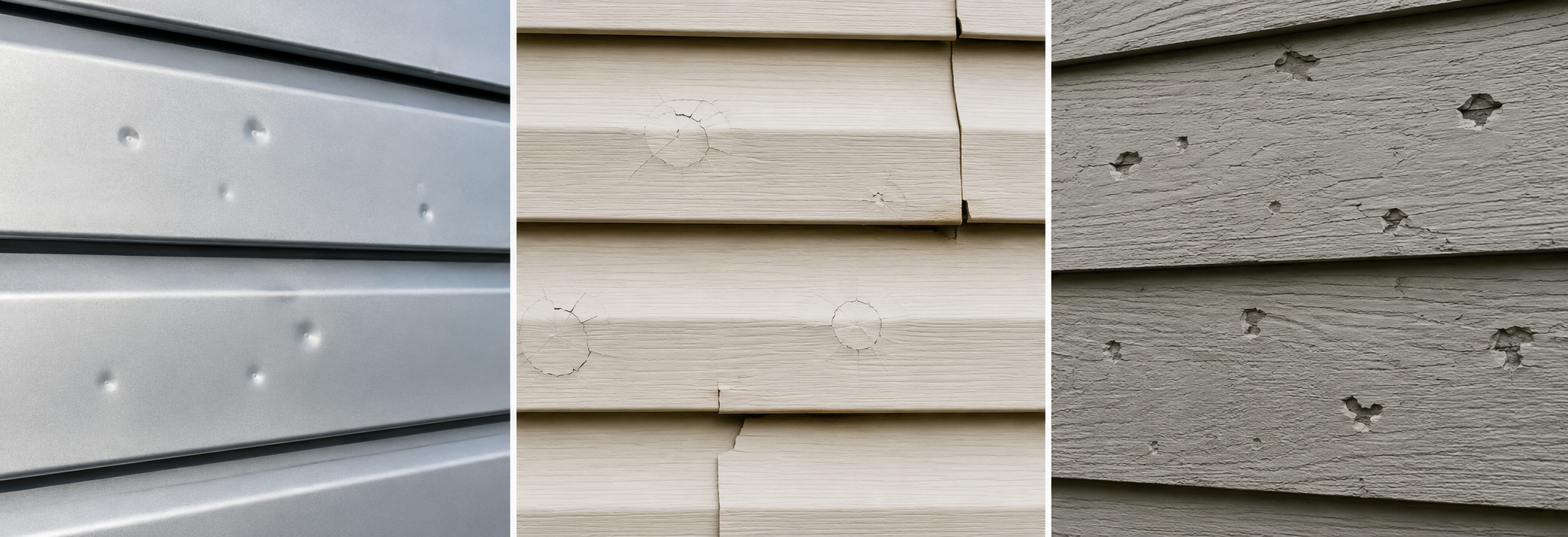
| Aluminum | Soft metal deforms on impact — hail leaves circular, concave dents without breaking the surface | Small round dents, often in a scattered pattern across the face; may have a dull versus glossy contrast at the dent edge | Raking-angle light (stand at one end of the wall, look along the surface at a low angle — dents cast visible shadows) |
| Vinyl (PVC) | Rigid material shatters or cracks at the impact point rather than denting — one-inch or larger hail can punch cleanly through thinner panels | Circular cracks, star-shaped fractures, or clean punch-through holes; near seams, hail can crack the locking channel | Close visual inspection from ladder or ground with binoculars; look for crack shadows on bright days |
| Fiber Cement (HardiePlank) | Dense material resists small hail well; larger impacts (golf-ball size and above) fracture the surface near edges and trim penetrations | Hairline cracks at the ends of planks, near window trim overlap, and at corner trim junctions; surface spalling where paint is disrupted | Close inspection of plank ends, corner trim lines, and window trim intersections; paint disruption signals the impact location |
Fayette and Coweta counties see hail events ranging from three-quarter inch to golf-ball size in a typical spring severe-weather season. Three-quarter inch hail is the threshold where aluminum siding begins to show visible dents and thinner vinyl panels begin to crack. At one inch, damage to all siding types is predictable. Golf-ball hail — one and three-quarter inches — dents aluminum deeply, shatters vinyl panels, and fractures fiber cement plank ends on any home in its path.
The most important field technique regardless of siding type is the raking-angle inspection. Stand at one end of a wall and look along the surface rather than straight at it. Morning or late-afternoon sunlight striking the wall at a low oblique angle casts shadows that reveal dents and surface deformations invisible when the wall is viewed head-on. This is the same technique professional storm assessors use systematically when documenting insurance claims.
Wind damage and hail damage are often assessed together after a Georgia storm, but they cause different types of problems. Hail creates discrete impact points. Wind creates linear failures — separated seams running horizontally across a wall section, lifted panel edges along the bottom run, and cracked or split panels where debris impact created a stress fracture rather than a circular dent.
The wind failures most likely to cause immediate water intrusion:
Storm Came Through Fayette or Coweta County? Sure Thing Roofing Contractor's no-cost inspection covers your complete building envelope — roof, gutters, fascia, and siding — with written documentation for your insurance claim. Schedule your inspection today.
Get No-Cost InspectionBy the time water infiltration behind siding becomes visible, it has already been happening for some time. The visible signs — staining, bubbling, mold at the base of panels — are the downstream evidence of a failure that started at a seam, a crack, or a trim penetration weeks or months earlier. Understanding what you are seeing and where the actual entry point is are two different questions.
The Georgia-specific factor that accelerates every one of these failure modes is humidity. Peachtree City and the surrounding Fayette and Coweta County communities experience high relative humidity from May through September. Any moisture that enters the wall cavity through damaged siding finds an environment ideally suited to mold establishment — warm temperatures, abundant organic material in wall sheathing and framing, and limited air exchange inside the wall cavity. The average timeline from siding water entry to detectable interior mold is shorter in Georgia's climate than in drier regions, which makes prompt post-storm inspection genuinely important rather than a precaution you can defer.
You do not need a ladder to do a useful first-pass siding inspection. Here is a systematic approach that takes twenty minutes and covers the most common storm-damage signs on any home.
One of the most common mistakes homeowners make after a significant storm is filing an insurance claim limited to roof damage when the siding damage on the same home is equally or more extensive. The claim amount, and therefore the repair scope, is limited by whatever is documented in the initial assessment. Siding damage identified and documented after the fact — in a supplement, weeks after the initial claim — is harder to get approved and creates a second round of adjuster visits.
Sure Thing Roofing Contractor's no-cost inspection documents the complete storm damage picture — roof, gutters, fascia, soffits, and siding — in a single assessment report that gives the insurance adjuster everything needed to scope the full claim in one visit. Our approach to roof replacement and full storm restoration is built around making the claim process straightforward for the homeowner. If you are scheduling a roof repair assessment, include the siding inspection in the same call — there is no additional cost and it protects the full scope of your claim.
If you have a leak, visible storm damage, or a roof that simply has not been looked at in the last few years, do not wait. A no-cost inspection costs you nothing and gives you the honest picture of where your roof stands.
Monday through Saturday, 9 AM to 6 PM. We confirm within one business hour.
Schedule Your No-Cost Roof InspectionOr call us directly: (678) 781-0045
Serving Peachtree City, Fayetteville, Newnan, McDonough, Senoia, Sharpsburg, Griffin, and Douglasville.
Peachtree City’s Atlas Pro+ certified roofer — since 2015. More than 60 five-star reviews.