 Sure Thing Roofing Contractor
Call Us Now
(678) 781-0045
Sure Thing Roofing Contractor
Sure Thing Roofing Contractor • Peachtree City, GA • Atlas Pro+ Certified • More than 60 Five-Star Reviews
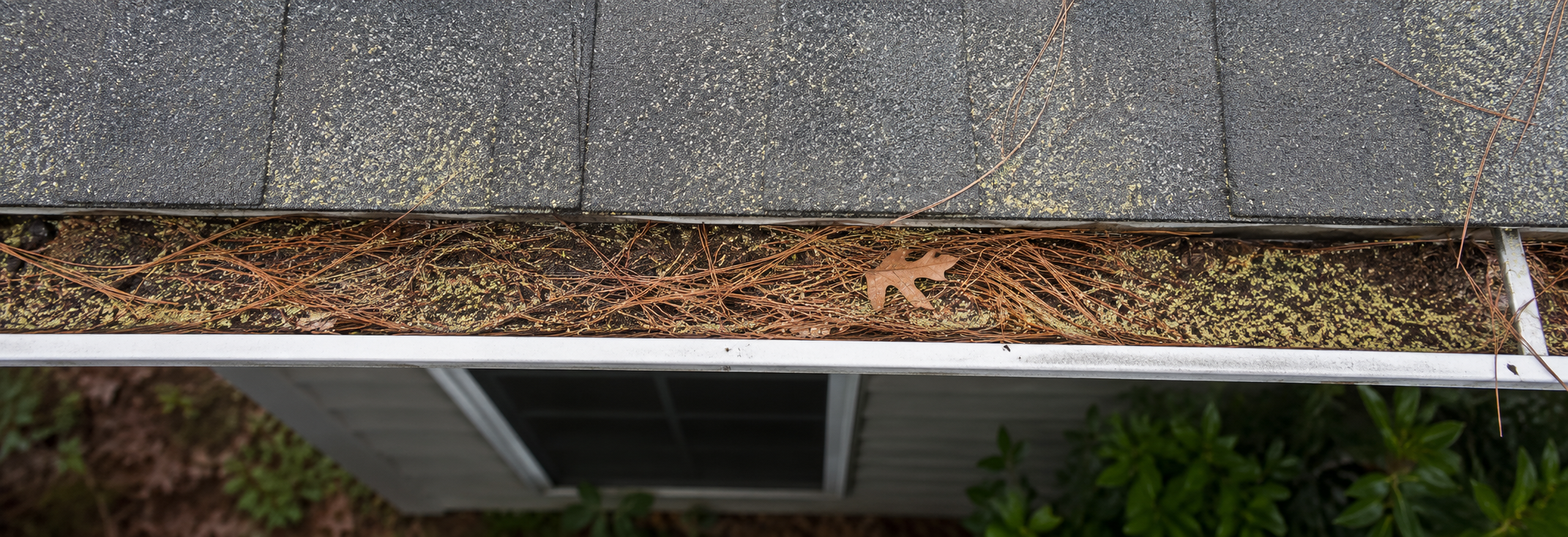
If you live in Peachtree City, Fayetteville, Senoia, or anywhere in Fayette County, your gutters face a specific and relentless problem that most gutter guard marketing does not address directly: pine needles.
The residential tree canopy in this part of Georgia is dominated by loblolly and longleaf pine. Unlike the broad leaves that most gutter systems were designed around, pine needles are narrow, dense, and compact. They do not flutter into gutters loosely. They pack together into a mat that holds moisture continuously against the fascia board behind the gutter — not just when it is raining, but for days afterward. That sustained moisture contact is what turns a gutter maintenance problem into a fascia rot problem, and eventually a roof repair conversation.
Overlay that pine needle load with Georgia's spring oak pollen season — when the fine yellow-green powder coats every horizontal surface across Fayette and Coweta counties — and the result is gutters that can go from clean to impacted in a matter of weeks during peak season. Add a severe storm that strips twigs and bark from the canopy above, and a gutter that was cleared last month can be fully blocked the morning after.
Sure Thing Roofing Contractor has assessed gutters on hundreds of homes in this area since 2015. With more than 60 five-star Google reviews and the full trust of this community, we are direct about what gutter guards can and cannot do — because the wrong guard in this environment performs worse than no guard at all. This guide covers what the Georgia debris environment actually demands, which guard types meet it, and what the math looks like on the investment.
Most of Georgia's gutter conversations are framed around fall leaf season. That framing misses the Peachtree City-specific reality. The most damaging debris type here is not leaves. It is pine needles, and they fall in all four seasons.
Loblolly and longleaf pines shed their oldest needles gradually throughout the year, with heavier drops in late summer and early winter. Unlike a maple or oak that drops its entire leaf load in a four-week window, a pine tree deposits material into your gutters from January through December. Every month. A homeowner who cleans gutters once in spring and once in fall is playing catch-up with a debris source that never stops producing.
The compaction issue is critical. A gutter channel filled with dry leaves is actually manageable — the leaves decompose, water passes through the gaps between them, and the visible overflow tells you it is time to clean. Pine needles behave differently. They compress into a mat roughly the consistency of wet felt. That mat sheds water over its surface rather than absorbing or passing it, causing overflow even when the gutter channel itself is not 100 percent full. And unlike leaves, the mat does not dry out and decompose quickly — it holds moisture against the back wall of the gutter for a week after a rain event in shaded areas.
The oak pollen layer compounds the problem in spring. Oak pollen is fine and sticky. When it mixes with pine needle mat debris, the combination forms a paste that seals downspout openings. A homeowner standing on the ground may see no visible debris in the gutter channel — the needles are compressed and laying flat — while the downspout below is completely blocked. The overflow during the next rain event does not look like a clogged gutter. It looks like a waterfall pouring off the fascia edge.
The practical consequence: homes in Peachtree City and Fayetteville under significant pine canopy need gutters cleaned three times per year at minimum — May, August, and December — to prevent the conditions that lead to fascia damage, overflow-driven foundation water, and ultimately premature roof replacement from eave deterioration. Gutter guards are the solution that reduces that maintenance burden to a manageable annual inspection rather than quarterly ladder work.
The water damage chain from clogged gutters follows a predictable sequence that gutter guards interrupt at the first step:
Gutter guards break this chain at step one. When debris cannot enter the gutter channel, it cannot block the downspout, which means the gutter continues to route water to the downspout rather than overflowing at the fascia. This is not a complicated mechanical principle — it is basic drainage. The challenge is finding a guard design that actually prevents pine needle entry in this specific environment.
The freeze-thaw angle matters specifically for this market. Peachtree City and Fayette County experience between 30 and 50 freeze-thaw cycles from November through February. A gutter channel packed with wet pine needle mat freezes solid during a hard freeze. The ice weight — which can be substantial across a full gutter run — puts direct downward force on the bracket attachments at the fascia. Brackets that were already stressed from debris load pull away from the fascia under the added ice weight. Guards that keep the channel clear of debris leave no wet material to freeze, which eliminates this failure mode entirely.
Heavy Pine Canopy Over Your Home?Sure Thing Roofing Contractor inspects your gutter condition and recommends the specific guard type that performs in your canopy load — at no cost. Written assessment included.
Schedule No-Cost Inspection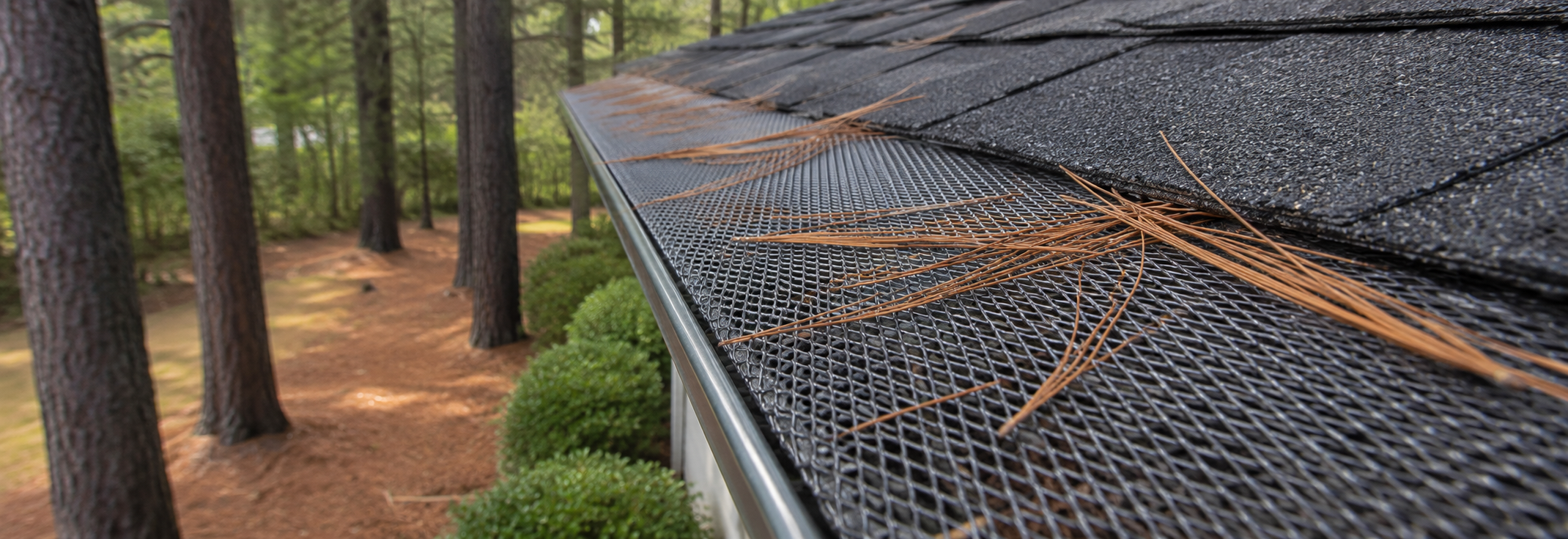
A fine stainless steel mesh bonded to an aluminum frame sits across the top of the gutter channel. The mesh openings are typically 50 microns or smaller — too fine for pine needles, oak pollen, or roof grit to enter. Water passes through the mesh by surface tension and falls into the channel below.
Water follows the curve of the guard into the gutter channel while leaves and large debris theoretically fall off the outer edge. The design was engineered for broad leaves, not pine needles. In Peachtree City's canopy environment, pine needles follow the water path over the curve and enter the channel, or accumulate at the curve and eventually block it.
Foam cylinders or flat foam sheets fill the gutter channel, allowing water to soak through while theoretically blocking debris on top. In Georgia's debris environment, pine needle mat, oak pollen paste, and roof grit compact into and around the foam within one to two seasons. The foam retains moisture continuously against the gutter interior, accelerating corrosion. Cleaning requires removing and replacing the foam.
Cylindrical brushes placed inside the gutter channel trap debris between the bristles while allowing water to pass. In Georgia's pine canopy environment, pine needles lock between the bristles within weeks of installation. The brush cannot be cleaned effectively in place — it must be removed, cleaned manually, and reinstalled. Many homeowners simply leave clogged brush guards in place, defeating the purpose entirely.
The honest statement about any gutter guard system — including micro-mesh — is that it does not permanently eliminate maintenance. What it does is change the maintenance profile from cleaning out the inside of the gutter channel four times per year to brushing or rinsing the outer mesh surface once per year. That is a meaningful reduction in both cost and safety risk. Micro-mesh guards in particular perform extremely well at keeping pine needles out of the channel, but fine pollen and roof granule sediment can accumulate on the mesh surface itself over time and may need to be cleared to maintain full flow capacity.
The ROI calculation for gutter guards is straightforward, but most homeowners only run half of it. They compare the installation cost against the cleaning cost and miss the avoided-damage cost entirely. Here is the complete picture:
| Cost Category | Without Guards | With Micro-Mesh Guards |
|---|---|---|
| Annual gutter cleaning | $450–$1,200/yr (3–4 cleanings) | $0–$150/yr (annual inspection/rinse) |
| 10-year cleaning cost | $4,500–$12,000 | $0–$1,500 |
| Guard installation cost | — | $1,000–$2,500 (one time) |
| 10-year net cost comparison | $4,500–$12,000 | $1,000–$4,000 |
| Fascia rot repair (if overflow causes damage) | $1,500–$5,000 (one event) | Risk dramatically reduced |
| Foundation water intrusion repair | $8,000–$30,000 (if damage occurs) | Risk dramatically reduced |
| Breakeven on cleaning costs alone: 2–3 years. Avoided damage value: potentially $10,000+. | ||
The avoided damage value is the column that tips the decision for most Peachtree City homeowners under significant pine canopy. A single fascia rot event that reaches the soffit and roof edge — the kind that starts as an overflow problem and graduates to structural repair territory — costs more than most gutter guard installations. The guard pays for itself in cleaning cost savings within two to three years. The potential fascia and foundation damage it prevents is the reason the ROI calculation is not even close in a high-debris environment like this one.
The comparison changes if the home has minimal tree canopy, well-maintained open space around the structure, and a homeowner who is committed to cleaning gutters on a consistent schedule. In that scenario, a guard investment takes longer to recover. The closer the home is to Peachtree City and Fayetteville's typical residential canopy density — which is significant — the faster the break-even point arrives.
Want to Know if Guards Make Financial Sense for Your Home?Sure Thing Roofing Contractor will assess your canopy load, current gutter condition, and existing overflow risk — and give you a straight answer. No-cost inspection, no obligation. Call (678) 781-0045.
Book Your No-Cost InspectionIf you have a leak, visible storm damage, or a roof that simply has not been looked at in the last few years, do not wait. A no-cost inspection costs you nothing and gives you the honest picture of where your roof stands.
Monday through Saturday, 9 AM to 6 PM. We confirm within one business hour.
Schedule Your No-Cost Roof InspectionOr call us directly: (678) 781-0045
Serving Peachtree City, Fayetteville, Newnan, McDonough, Senoia, Sharpsburg, Griffin, and Douglasville.
Peachtree City’s Atlas Pro+ certified roofer — since 2015. More than 60 five-star reviews.